

CNSP Dumps with Practice Exam Questions Answers
CNSP by Security Practitioner Actual Free Exam Practice Test
The SecOps Group CNSP Exam Syllabus Topics:
| Topic | Details |
|---|---|
| Topic 1 |
|
| Topic 2 |
|
| Topic 3 |
|
| Topic 4 |
|
| Topic 5 |
|
| Topic 6 |
|
| Topic 7 |
|
| Topic 8 |
|
| Topic 9 |
|
| Topic 10 |
|
| Topic 11 |
|
| Topic 12 |
|
| Topic 13 |
|
| Topic 14 |
|
| Topic 15 |
|
| Topic 16 |
|
NEW QUESTION # 14
The Active Directory database file stores the data and schema information for the Active Directory database on domain controllers in Microsoft Windows operating systems. Which of the following file is the Active Directory database file?
- A. MSAD.MDB
- B. NTDS.MDB
- C. NTDS.DAT
- D. NTDS.DIT
Answer: D
Explanation:
The Active Directory (AD) database on Windows domain controllers contains critical directory information, stored in a specific file format.
Why D is correct: The NTDS.DIT file (NT Directory Services Directory Information Tree) is the Active Directory database file, located in C:\Windows\NTDS\ on domain controllers. It stores all AD objects (users, groups, computers) and schema data in a hierarchical structure. CNSP identifies NTDS.DIT as the key file for AD data extraction in security audits.
Why other options are incorrect:
A . NTDS.DAT: Not a valid AD database file; may be a confusion with other system files.
B . NTDS.MDB: Refers to an older Microsoft Access database format, not used for AD.
C . MSAD.MDB: Not a recognized file for AD; likely a misnomer.
NEW QUESTION # 15
Where are the password hashes stored in the Linux file system?
- A. /usr/bin/shadow
- B. /etc/shadow
- C. /etc/password
- D. /etc/passwd
Answer: B
Explanation:
In Linux, password hashes are stored in a secure file to protect user authentication data. The evolution of Linux security practices moved password storage from plaintext or weakly protected files to a more secure location.
Why C is correct: The /etc/shadow file is the standard location for storing password hashes in modern Linux systems. This file is readable only by the root user, enhancing security by restricting access. It contains encrypted password hashes (typically using algorithms like SHA-512), along with user details such as password expiration policies. CNSP documentation on Linux security emphasizes /etc/shadow as the authoritative source for password hashes, replacing older methods.
Why other options are incorrect:
A . /etc/passwd: Historically, /etc/passwd stored passwords in plaintext or weakly hashed forms (e.g., using DES), but modern systems use it only for user account information (e.g., UID, GID, home directory) and reference /etc/shadow for hashes.
B . /etc/password: This is not a valid file in the Linux file system; it appears to be a typographical error or misunderstanding, with no recognized role in password storage.
D . /usr/bin/shadow: /usr/bin contains executable binaries, not configuration or data files like password hashes. /etc/shadow is the correct path.
NEW QUESTION # 16
On a Microsoft Windows Operating System, what does the following command do?
net localgroup administrators
- A. List domain admin users for the current domain
- B. Displays the local administrators group on the computer
Answer: B
Explanation:
The net command in Windows is a legacy tool for managing users, groups, and network resources. The subcommand net localgroup <groupname> displays information about a specified local group on the machine where it's run. Specifically:
net localgroup administrators lists all members (users and groups) of the local Administrators group on the current computer.
The local Administrators group grants elevated privileges (e.g., installing software, modifying system files) on that machine only, not domain-wide.
Output Example:
Alias name administrators
Comment Administrators have complete and unrestricted access to the computer Members
------------------------------------------------------------------------------- Administrator Domain Admins The command completed successfully.
Technical Details:
Local groups are stored in the Security Accounts Manager (SAM) database (e.g., C:\Windows\System32\config\SAM).
This differs from domain groups (e.g., Domain Admins), managed via Active Directory.
Security Implications: Enumerating local admins is a reconnaissance step in penetration testing (e.g., to escalate privileges). CNSP likely covers this command for auditing and securing Windows systems.
Why other options are incorrect:
A . List domain admin users for the current domain: This requires net group "Domain Admins" /domain, which queries the domain controller, not the local SAM. net localgroup is strictly local.
Real-World Context: Attackers use this command post-compromise (e.g., via PsExec) to identify privilege escalation targets.
NEW QUESTION # 17
Which of the following is a valid DNS record type?
- A. TXT record
- B. SRV record
- C. All of the above
- D. NAPTR record
Answer: C
Explanation:
DNS (Domain Name System) records define how domain names are mapped to various types of data, each serving a specific purpose in network operations. The question asks for valid DNS record types, and all listed options are recognized.
Why D is correct:
A . NAPTR record: The Naming Authority Pointer (NAPTR) record is used for service discovery and mapping domain names to services, protocols, and ports (e.g., in SIP or ENUM systems).
B . SRV record: The Service (SRV) record specifies the hostname and port for specific services (e.g., LDAP, XMPP), aiding in service location.
C . TXT record: The Text (TXT) record stores arbitrary text data, often for SPF, DKIM, or domain verification.
All are valid DNS record types per RFC standards and CNSP documentation, making "All of the above" the correct answer.
Why other options are incomplete: A, B, or C alone exclude other valid types listed, so D is the most comprehensive response.
NEW QUESTION # 18
Which of the following files has the SGID permission set?
-rwxr-sr-x 1 root root 4096 Jan 1 08:00 myfile
-rwsr-xr-x 1 root root 4096 Jan 1 00:08 myprogram
-rw-r--r-s 1 root root 4896 Jan 1 00:00 anotherfile
- A. All of the above
- B. myfile
- C. anotherfile
- D. myprogram
Answer: B
Explanation:
In Linux, the SGID (Set Group ID) bit alters execution or directory behavior:
On executables: Runs with the group owner's permissions (e.g., s in group execute position).
On directories: New files inherit the directory's group ownership.
Notation: s in group execute field (e.g., -rwxr-sr-x), or S if no execute (e.g., -rwxr-Sr-x).
Analysis:
-rwxr-sr-x (myfile): User: rwx, Group: r-s (SGID), Others: r-x. The s in group execute confirms SGID.
-rwsr-xr-x (myprogram): User: rws (SUID), Group: r-x, Others: r-x. The s is in user execute, not group-no SGID.
-rw-r--r-s (anotherfile): User: rw-, Group: r--, Others: r-s. The s is in others execute, but no x exists, rendering it meaningless (not SGID; could be a typo or sticky bit misapplied).
Security Implications: SGID executables (e.g., /usr/bin/wall) or directories (e.g., /var/local) manage group access. Misuse risks privilege escalation. CNSP likely teaches auditing with find / -perm -g=s.
Why other options are incorrect:
B: SUID, not SGID.
C: No valid SGID; s in others is irrelevant without execute.
D: Only A has SGID.
Real-World Context: SGID on /var/mail ensures mail files inherit the mail group.
NEW QUESTION # 19
In the context of the SSH (Secure Shell) public-private key authentication mechanism, which key is uploaded to the server and which key is used by the end-user for authentication?
- A. The public key is uploaded to the server and the private key is used by the end user for authentication.
- B. The private key is uploaded to the server and the public key is used by the end user for authentication.
Answer: A
Explanation:
SSH (Secure Shell), per RFC 4251, uses asymmetric cryptography (e.g., RSA, ECDSA) for secure authentication:
Key Pair:
Public Key: Freely shareable, used to encrypt or verify.
Private Key: Secret, used to decrypt or sign.
Process:
User generates a key pair (e.g., ssh-keygen -t rsa -b 4096).
Public Key is uploaded to the server, appended to ~/.ssh/authorized_keys (e.g., via ssh-copy-id).
Private Key (e.g., ~/.ssh/id_rsa) stays on the user's machine.
Authentication: Client signs a challenge with the private key; server verifies it with the public key.
Technical Details:
Protocol: SSH-2 (RFC 4253) uses a Diffie-Hellman key exchange, then public-key auth.
Files: authorized_keys (server, 0644 perms), private key (client, 0600 perms).
Security: Private key exposure compromises all systems trusting the public key.
Security Implications: CNSP likely stresses key management (e.g., passphrases, rotation) and server-side authorized_keys hardening (e.g., PermitRootLogin no).
Why other options are incorrect:
B: Uploading the private key reverses the model, breaking security-anyone with the server's copy could authenticate as the user. Asymmetric crypto relies on the private key remaining secret.
Real-World Context: GitHub uses SSH public keys for repository access, with private keys on user devices.
NEW QUESTION # 20
In a Linux-based architecture, what does the /mnt directory contain?
- A. System configuration files and initialization scripts
- B. Loadable driver modules needed to boot the system
- C. Temporary-mounted filesystems
- D. System files which represent the current state of the kernel
Answer: C
Explanation:
The Linux Filesystem Hierarchy Standard (FHS), per FHS 3.0, defines directory purposes:
/mnt: Designated for temporarily mounted filesystems, typically by system administrators.
Use: Mount points for removable media (e.g., USB drives: mount /dev/sdb1 /mnt/usb) or network shares (e.g., NFS).
Nature: Transient, user-managed, not persistent across reboots (unlike /etc/fstab mounts).
Contrast:
/media: Auto-mounts removable devices (e.g., by desktop environments like GNOME).
/mnt vs. /media: /mnt is manual, /media is system-driven.
Technical Details:
Empty by default; subdirectories (e.g., /mnt/usb) are created as needed.
Permissions: Typically root-owned (0755), requiring sudo for mounts.
Security Implications: Misconfigured /mnt mounts (e.g., world-writable) risk unauthorized access. CNSP likely covers mount security (e.g., nosuid option).
Why other options are incorrect:
B . System config/init scripts: Found in /etc (e.g., /etc/passwd, /etc/init.d).
C . Driver modules: Located in /lib/modules/<kernel-version>.
D . Kernel state: Resides in /proc (e.g., /proc/cpuinfo).
Real-World Context: Admins mount ISOs at /mnt during server provisioning (e.g., mount -o loop image.iso /mnt).
NEW QUESTION # 21
What kind of files are "Dotfiles" in a Linux-based architecture?
- A. Driver files
- B. Library files
- C. System files
- D. Hidden files
Answer: D
Explanation:
In Linux, file visibility is determined by naming conventions, impacting how files are listed or accessed in the file system.
Why D is correct: "Dotfiles" are files or directories with names starting with a dot (e.g., .bashrc), making them hidden by default in directory listings (e.g., ls requires -a to show them). They are commonly used for user configuration, as per CNSP's Linux security overview.
Why other options are incorrect:
A: Library files (e.g., in /lib) aren't inherently hidden.
B: Driver files (e.g., kernel modules in /lib/modules) aren't dotfiles by convention.
C: System files may or may not be hidden; "dotfiles" specifically denotes hidden status.
NEW QUESTION # 22
Which SMB (Server Message Block) network protocol version introduced support for encrypting SMB traffic?
- A. SMBv1
- B. SMBv3
- C. SMBv2
- D. None of the above
Answer: B
Explanation:
The SMB protocol, used for file and printer sharing, has evolved across versions, with significant security enhancements in later iterations.
Why C is correct: SMBv3, introduced with Windows 8 and Server 2012, added native support for encrypting SMB traffic. This feature uses AES-CCM encryption to protect data in transit, addressing vulnerabilities in earlier versions. CNSP notes SMBv3's encryption as a critical security improvement.
Why other options are incorrect:
A . SMBv1: Lacks encryption support and is considered insecure, often disabled due to vulnerabilities like WannaCry exploitation.
B . SMBv2: Introduces performance improvements but does not support encryption natively.
D . None of the above: Incorrect, as SMBv3 is the version that introduced encryption.
NEW QUESTION # 23
Which of the following algorithms could be used to negotiate a shared encryption key?
- A. Triple-DES
- B. Diffie-Hellman
- C. SHA1
- D. AES
Answer: B
Explanation:
Negotiating a shared encryption key involves a process where two parties agree on a secret key over an insecure channel without directly transmitting it. This is distinct from encryption or hashing algorithms, which serve different purposes.
Why C is correct: The Diffie-Hellman (DH) algorithm is a key exchange protocol that enables two parties to establish a shared secret key using mathematical operations (e.g., modular exponentiation). It's widely used in protocols like TLS and IPsec, as noted in CNSP for secure key negotiation.
Why other options are incorrect:
A: Triple-DES is a symmetric encryption algorithm for data encryption, not key negotiation.
B: SHA1 is a hash function for integrity, not key exchange.
D: AES is a symmetric encryption algorithm, not a key exchange mechanism.
NEW QUESTION # 24
What user account is required to create a Golden Ticket in Active Directory?
- A. Local User account
- B. Service account
- C. Domain User account
- D. KRBTGT account
Answer: D
Explanation:
A Golden Ticket is a forged Kerberos Ticket-Granting Ticket (TGT) in Active Directory (AD), granting an attacker unrestricted access to domain resources by impersonating any user (e.g., with Domain Admin privileges). Kerberos, per RFC 4120, relies on the KRBTGT account-a built-in service account on every domain controller-to encrypt and sign TGTs. To forge a Golden Ticket, an attacker needs:
The KRBTGT password hash (NTLM or Kerberos key), typically extracted from a domain controller's memory using tools like Mimikatz.
Additional domain details (e.g., SID, domain name).
Process:
Compromise a domain controller (e.g., via privilege escalation).
Extract the KRBTGT hash (e.g., lsadump::dcsync /user:krbtgt).
Forge a TGT with arbitrary privileges using the hash (e.g., Mimikatz's kerberos::golden command).
The KRBTGT account itself isn't "used" to create the ticket; its hash is the key ingredient. Unlike legitimate TGTs issued by the KDC, a Golden Ticket bypasses authentication checks, persisting until the KRBTGT password is reset (a rare event in most environments). CNSP likely highlights this as a high-severity AD attack vector.
Why other options are incorrect:
A . Local User account: Local accounts are machine-specific, lack domain privileges, and can't access the KRBTGT hash stored on domain controllers.
B . Domain User account: A standard user has no inherent access to domain controller credentials or the KRBTGT hash without escalation.
C . Service account: While service accounts may have elevated privileges, they don't automatically provide the KRBTGT hash unless compromised to domain admin level-still insufficient without targeting KRBTGT specifically.
Real-World Context: The 2014 Sony Pictures hack leveraged Golden Tickets, emphasizing the need for KRBTGT hash rotation post-breach (a complex remediation step).
NEW QUESTION # 25
You are performing a security audit on a company's network infrastructure and have discovered the SNMP community string set to the default value of "public" on several devices. What security risks could this pose, and how might you exploit it?
- A. Both A and B.
- B. None of the above.
- C. The potential risk is that an attacker could use the SNMP protocol to gather sensitive information about the devices. You might use a tool like Snmpwalk to query the devices for information.
- D. The potential risk is that an attacker could use the SNMP protocol to modify the devices' configuration settings. You might use a tool like Snmpset to change the settings.
Answer: C
Explanation:
SNMP (Simple Network Management Protocol) uses community strings as a basic form of authentication. The default read-only community string "public" is widely known, and if left unchanged, it exposes devices to unauthorized access. The primary risk with "public" is information disclosure, as it typically grants read-only access, allowing attackers to gather sensitive data (e.g., device configurations, network topology) without altering settings.
Why A is correct: With the "public" string, an attacker can use tools like snmpwalk to enumerate device details (e.g., system uptime, interfaces, or software versions) via SNMP queries. This aligns with CNSP's focus on reconnaissance risks during security audits, emphasizing the danger of default credentials enabling passive data collection.
Why other options are incorrect:
B: While modifying settings is a risk with SNMP, the default "public" string is typically read-only. Changing configurations requires a read-write community string (e.g., "private"), which isn't implied here. Thus, snmpset would not work with "public" alone.
C: Since B is incorrect in this context, C (both A and B) cannot be the answer.
D: The risk in A is valid, so "none of the above" is incorrect.
NEW QUESTION # 26
What is the response from a closed UDP port which is not behind a firewall?
- A. No response
- B. ICMP message showing Destination Unreachable
- C. None of the above
- D. A RST packet
Answer: B
Explanation:
UDP is a connectionless protocol, and its behavior when a packet reaches a port depends on whether the port is open or closed. Without a firewall altering the response, the standard protocol applies.
Why A is correct: When a UDP packet is sent to a closed port, the host typically responds with an ICMP Type 3 (Destination Unreachable), Code 3 (Port Unreachable) message, indicating no service is listening. CNSP notes this as a key indicator in port scanning.
Why other options are incorrect:
B: RST packets are TCP-specific, not used in UDP.
C: No response occurs for open UDP ports unless an application replies, not closed ports.
D: A is correct, so "none of the above" is invalid.
NEW QUESTION # 27
Which one of the following is a phishing email?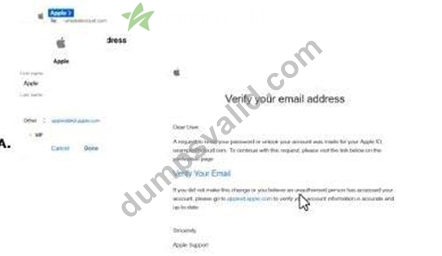

- A. Only B
- B. Only A
- C. None of the above
- D. Both A and B
Answer: A
Explanation:
The screenshot shows an email labeled "B" with the subject "Verify your email address" purportedly from Apple. To determine if this is a phishing email, we need to analyze its content and characteristics against common phishing indicators as outlined in CNSP documentation. Since option A is not provided in the screenshot, we will evaluate email B and infer the context for A.
Analysis of Email B:
Sender and Branding: The email claims to be from "Apple Support" and includes an Apple logo, which is a common tactic to establish trust. However, phishing emails often impersonate legitimate brands like Apple to deceive users.
Subject and Content: The subject "Verify your email address" and the body requesting the user to verify their email by clicking a link ("Verify Your Email") are typical of phishing attempts. Legitimate companies like Apple may send verification emails, but the tone and context here raise suspicion.
Link Presence: The email contains a clickable link ("Verify Your Email") that is purportedly for email verification. The screenshot does not show the URL, but phishing emails often include malicious links that lead to fake login pages to steal credentials. CNSP emphasizes that unsolicited requests to click links for verification are a red flag.
Urgency and Vague Instructions: The email includes a statement, "If you did not make this change or believe an unauthorized person has accessed your account, click here to cancel and secure your account." This creates a sense of urgency, a common phishing tactic to prompt immediate action without critical thinking.
Generic Greeting: The email starts with "Dear User," a generic greeting often used in phishing emails. Legitimate companies like Apple typically personalize emails with the user's name.
Suspicious Elements: The email mentions "your Apple ID ([email protected])," which is a placeholder rather than a specific email address, further indicating a mass phishing campaign rather than a targeted, legitimate communication.
Phishing Indicators (per CNSP):
CNSP documentation on phishing identification lists several red flags:
Unsolicited requests for verification or account updates.
Generic greetings (e.g., "Dear User" instead of a personalized name).
Presence of links that may lead to malicious sites (not verifiable in the screenshot but implied).
Urgency or threats (e.g., "click here to cancel and secure your account").
Impersonation of trusted brands (e.g., Apple).
Email B exhibits multiple indicators: the generic greeting, unsolicited verification request, urgent call to action, and impersonation of Apple.
Option A Context:
Since the screenshot only shows email B, and the correct answer is "Only B," we can infer that email A (not shown) does not exhibit phishing characteristics. For example, A might be a legitimate email from Apple with proper personalization, no suspicious links, or a different context (e.g., a purchase confirmation rather than a verification request).
Evaluation of Options:
1. Only A: Incorrect, as email A is not shown, and the correct answer indicates B as the phishing email.
2. Only B: Correct. Email B shows clear phishing characteristics, such as impersonation, a generic greeting, an unsolicited verification link, and urgency, aligning with CNSP's phishing criteria.
3. Both A and B: Incorrect, as A is implied to be non-phishing based on the correct answer.
4. None of the above: Incorrect, as B is a phishing email.
Conclusion: Email B is a phishing email due to its impersonation of Apple, generic greeting, unsolicited verification request with a link, and use of urgency to prompt action. Since A is not shown but implied to be non-phishing, the correct answer is "Only B."
NEW QUESTION # 28
Which of the following represents a valid Windows Registry key?
- A. HKEY_LOCAL_MACHINE
- B. HKEY_ROOT_CLASSES
- C. HKEY_INTERNAL_CONFIG
- D. HKEY_LOCAL_USER
Answer: A
Explanation:
The Windows Registry is a hierarchical database storing system and application settings, organized into predefined root keys (hives). Only specific names are valid as top-level keys.
Why A is correct: HKEY_LOCAL_MACHINE (HKLM) is a standard root key containing hardware and system-wide configuration data. CNSP references it for security settings analysis (e.g., auditing policies).
Why other options are incorrect:
B: HKEY_INTERNAL_CONFIG is not a valid key; no such hive exists.
C: HKEY_ROOT_CLASSES is a misspelling; the correct key is HKEY_CLASSES_ROOT (HKCR).
D: HKEY_LOCAL_USER is incorrect; the valid key is HKEY_CURRENT_USER (HKCU).
NEW QUESTION # 29
What is the response from a closed TCP port which is not behind a firewall?
- A. ICMP message showing Port Unreachable
- B. A RST and an ACK packet
- C. A SYN and an ACK packet
- D. A FIN and an ACK packet
Answer: B
Explanation:
TCP uses a structured handshake, and its response to a connection attempt on a closed port follows a specific protocol when unobstructed by a firewall.
Why C is correct: A closed TCP port responds with a RST (Reset) and ACK (Acknowledgment) packet to terminate the connection attempt immediately. CNSP highlights this as a key scanning indicator.
Why other options are incorrect:
A: ICMP Port Unreachable is for UDP, not TCP.
B: FIN/ACK is for closing active connections, not rejecting new ones.
D: SYN/ACK indicates an open port during the TCP handshake.
NEW QUESTION # 30
How would you establish a null session to a Windows host from a Windows command prompt?
- A. net use \hostname\c$ "" /u:NULL
- B. net use \hostname\ipc$ "" /u:""
- C. net use \hostname\ipc$ "" /u:NULL
- D. net use \hostname\c$ "" /u:""
Answer: B
Explanation:
A null session in Windows is an unauthenticated connection to certain administrative shares, historically used for system enumeration. The net use command connects to a share, and the IPC$ (Inter-Process Communication) share is the standard target for null sessions, allowing access without credentials when configured to permit it.
Why C is correct: The command net use \\hostname\ipc$ "" /u:"" specifies the IPC$ share and uses empty strings for the password (first "") and username (/u:""), establishing a null session. This syntax is correct for older Windows systems (e.g., XP or 2003) where null sessions were more permissive, a topic covered in CNSP for legacy system vulnerabilities.
Why other options are incorrect:
A: Targets the c$ share (not typically used for null sessions) and uses /u:NULL, which is invalid syntax; the username must be an empty string ("").
B: Targets c$ instead of ipc$, making it incorrect for null session establishment.
D: Uses ipc$ correctly but specifies /u:NULL, which is not the proper way to denote an empty username.
NEW QUESTION # 31
What will be the subnet mask for 192.168.0.1/18?
- A. 255.255.255.0
- B. 255.225.225.0
- C. 255.255.192.0
- D. 255.225.192.0
Answer: C
Explanation:
An IP address with a /18 prefix (CIDR notation) indicates 18 network bits in the subnet mask, leaving 14 host bits (32 total bits - 18). For IPv4 (e.g., 192.168.0.1):
Binary Mask: First 18 bits are 1s, rest 0s.
1st octet: 11111111 (255)
2nd octet: 11111111 (255)
3rd octet: 11000000 (192)
4th octet: 00000000 (0)
Decimal: 255.255.192.0
Calculation:
Bits: /18 = 2^14 hosts (16,384), minus 2 (network/broadcast) = 16,382 usable.
Range: 192.168.0.0-192.168.63.255 (3rd octet: 0-63, as 192 = 11000000 covers 6 bits).
Technical Details:
Subnet masks align on octet boundaries or mid-octet (e.g., 192 = 2^7 + 2^6).
Contrast: /24 = 255.255.255.0 (256 hosts), /16 = 255.255.0.0 (65,536 hosts).
Security Implications: Larger subnets (e.g., /18) increase broadcast domains, risking amplification attacks. CNSP likely teaches subnetting for segmentation (e.g., VLANs).
Why other options are incorrect:
A . 255.255.255.0: /24 (8 host bits), not /18.
B . 255.225.225.0: Invalid mask (225 = 11100001, non-contiguous 1s).
D . 255.225.192.0: Invalid (225 breaks binary sequence).
Real-World Context: Subnetting 192.168.0.0/18 isolates departments in enterprise networks.
NEW QUESTION # 32
......
Free Security Practitioner CNSP Exam Question: https://examcollection.dumpsvalid.com/CNSP-brain-dumps.html