

Updated Jun-2026 Exam Materials for You to Prepare & Pass Mule-Dev-201 Exam.
Pass Your Mule-Dev-201 Exam at the First Try with 100% Real Exam
NEW QUESTION # 117
Refer to theexhibits. In the choice router, the When expression for the domestic shipping route is set to "#
[payload= "FR"]".
What is the output of logger after the execution of choice router is completed?
- A. "International"
- B. "Domestic"
- C. "US"
- D. A dataweave syntax error
Answer: D
Explanation:
To compare, DataWeave syntax is #[payload == "FR"].
In this case only one = is used so it will give syntax error.
Hence the correct answer is A dataweave syntax error
NEW QUESTION # 118
A Mule application contains an ActiveMQ JMS dependency. The Mule application was developed in Anypoint Studio and runs successfully in Anypoint Studio.
The Mule application must now be exported from Anypoint Studio and shared with another developer.
What export options create the smallest JAR file that can be imported into the other developer's Anypoint Studio and run successfully?
- A. Option C
- B. Option D
- C. Option A
- D. Option B
Answer: B
NEW QUESTION # 119
Refer to the exhibit. The input array of stringsis passed to the batch job, which does NOT do any filtering or aggregating. What payload is logged by the Logger component?
- A. Summary report of processed records
- B. [ "Apptel2", "Bananal2" ]
- C. [ "Apple", "Banana" ]
- D. [ "Apptel", "Bananal", 2 ]
Answer: A
NEW QUESTION # 120
An organization is beginning to follow Mulesoft's recommendedAPI led connectivity approach to use modern API to support the development and lifecycle of the integration solutions and to close the IT delivery gap.
What distinguishes between how modern API's are organized in a MuleSoft recommended API-led connectivityapproach as compared to other common enterprise integration solutions?
- A. The APIO implementations are monitoredwith common tools, centralized monitoring and security systems
- B. The API interfaces are specified as macroservices with one API representing all the business logic of an existing and proven end to end solution
- C. The API implementation are built with standards using common lifecycle and centralized configuration management tools
- D. The API interfaces are specifiedat a granularity intended for developers to consume specific aspect of integration processes
Answer: D
Explanation:
Correct answer is The API interfaces are specified at a granularity intended for developers to consume specific aspect of integration processes
NEW QUESTION # 121
What of the below is not a feature of API Notebooks?
- A. Perform authenticated live calls on a real server
- B. API documentation
- C. Creates a client for an API
- D. Creates a mock service for an API
Answer: D
Explanation:
Correct answer is Creates a mock service for an API
API Notebook is an open source, shareable web application for API documentation, interactive API tutorial and example generatation, and a client for your API endpoints. Using API Notebook, you can make requests and quickly transform the responses into readable format. However it cannot be used to mock service for an API.
MuleSoft Doc Ref : https://docs.mulesoft.com/api-manager/1.x/api-notebook-concept
NEW QUESTION # 122
Refer to the exhibit.
What is the correct DataWeave expression for the Set Payload transformer to call the createCustomerObject flow with values for the first and last names of a new customer?
- A. lookupf "createCustomerObject", { first: "Alice", last: "Green" > )
- B. lookupC createCustomerObJect( "Alice", "Green- ) )
- C. createCustomerObject( { first: "Alice", last: "Green" > )
- D. createCustomerObject( "Alice", "Green")
Answer: A
Explanation:
lookup(String,Any, Number)
This function enables you to execute a flow within a Mule app and retrieve the resulting payload.
It works in Mule apps that are running on Mule Runtime version 4.1.4 and later.
Similar to the Flow Reference component (recommended), the lookup function enables you to execute another flow within your app and to retrieve the resulting payload. It takes the flow's name and an input payload as parameters. For example, lookup("anotherFlow", payload) executes a flow named anotherFlow.
Correct answeris
lookup( "createCustomerObject", {first: "Aice, last: "Green"})
MuleSoft Documentation Reference : https://docs.mulesoft.com/mule-runtime/4.3/dw-mule-functions-lookup
NEW QUESTION # 123
As a part of requirement , application property defined below needs to be accessed as dataweave expression.
What is the correct expression to map it to port value?
- A. { port : p('db.port')}
- B. { port : p['db.port']}
- C. { port : {db:port}}
- D. Application property cannot be accessed in Dataweave
Answer: A
Explanation:
Option 1 is the correct syntax
NEW QUESTION # 124
Refer to the exhibits.
This main mule application calls a separate flow called as ShippingAddress which returns the address corresponding to the name of the user sent to it as input. Output of this ShippingAddress is stored in a target variable named address.
Next set of requirement is to have a setPayload transformer which will set below two values
1) orderkey which needs to set to be equal to the order element received in the original request payload.
2) addressKey which needs to be set to be equalto the address received in response of ShippingAddress flow What is the straightforward way to properly configure the Set Payload transformer with the required data?

A mule application is being developed which will process POST requests coming fromclients containing the name and order information. Sample request is as below
- A. 1. 1. {2. 2. orderkey: "attributes.order",3. 3. addresskey: "vars.address"4. }
- B. 1. 1. {2. 2. orderkey: "payload.order",3. 3. addresskey: "vars.address"4. 4. }
- C. 1. 1. {2. 2. orderkey: "payload.order",3. 3. addresskey: "address"4. }
- D. 1. 1. {2. 2. orderkey: "attributes.shippingaddress.order",3. 3. addresskey: "payload"4.}
Answer: B
Explanation:
Correct answer is as below. In this case address will be stored in a variable. Hence payload will not be overwritten and will contain order details
{
orderkey: "payload.order",
addresskey: "vars.address"
}
NEW QUESTION # 125
The new RAML spec has been published to Anypoint Exchange with client credentials.
What is the next step to gain access to the API?
- A. No additional steps needed
- B. Email the owners of the API
- C. Create a new client application
- D. Request access to the API in Anypoint Exchange
Answer: D
Explanation:
Correct answer is Request access to the API in Anypoint Exchange. This way we can get clientId and Client secret which we can use to access the API
NEW QUESTION # 126
Which keyword do you use to create a new function in DataWeave?
- A. function
- B. map
- C. fun
- D. func
Answer: C
Explanation:
You can define your own DataWeave functionsusing the fun declaration in the header of a DataWeave script.
Sample is as below. ----------------------------------------
%dw 2.0
output application/json
fun toUpper(aString) = upper(aString)
---
toUpper("hello")
MuleSoft Doc Ref : https://docs.mulesoft.com/mule-runtime/4.1/dataweave-functions
NEW QUESTION # 127
What asset cannot be created using Design Center?
- A. Mule Applications
- B. API portals
- C. API fragments
- D. API specifications
Answer: B
Explanation:
API portal are created by API Exchange and cannot be created by Design Center
NEW QUESTION # 128
Refer to the exhibit.
What should be changed to fix the 415 error?
- A. set the response Content-Type header to text/plain
- B. Set the request Content-Type header to application/] son
- C. set theresponse Content-Type header to application/json
- D. set the request Content-Type header to text/plain
Answer: B
Explanation:
The HTTP 415 Unsupported Media Type client error response code indicates that the server refuses to accept the request because the payload format is in an unsupported format. The format problem might be due to the request's indicated Content-Type or Content-Encoding , or as a result of inspecting the data directly. In this case as per RAML specification data is expected in application/json and in request Content-Type is set as "text
/plain" which is incorrect. Hence solution is set the request Content-Type header to application/json
https://developer.mozilla.org/en-US/docs/Web/HTTP/Status/415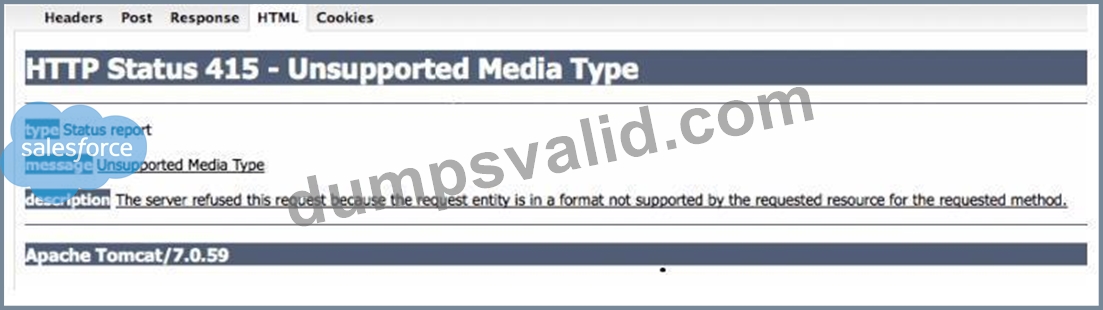
NEW QUESTION # 129
What valid RAML retrieves details on a specific customer by its customerId as a URI parameter?
- A. 1. /customers:2. /{customerId}:3. get:
- B. 1. /customers:2. get:3. /{customerId}:
- C. 1. /customers:2. /customerId:3. get:
- D. 1. /customers:2. /get:3. /customerId:
Answer: A
Explanation:
Correct answer is below as it follows the correct syntax.
/customers:
/{customerId}:
get:
NEW QUESTION # 130
Refer to the exhibits.
The mule application is debugged in Anypoint Studio and stops at the breakpoint as shown in below exhibit.
What is the value of the payload displayed in the debugger at this breakpoint?
- A. Finished
- B. Process
- C. Payload is always empty at the breakpoint
- D. Start
Answer: D
Explanation:
Setting Breakpoints
To set breakpoints, right-click a building block, then select Toggle Breakpoint.
Studio applies a red dot to the building block's icon on the canvas.
When you run your application in Debug mode, Studio stops the flow execution at the breakpoint you have set, allowing you to check the Mule Event content in the Mule Debugger View.
Mule Ref Doc : Setting Breakpoints | MuleSoft Documentation
NEW QUESTION # 131
Acompany has an API to manage purchase orders, with each record identified by a unique purchase order ID.
The API was built with RAML according to MuleSoft best practices.
What URI should a web client use to request order P05555?
- A. /orders/order=P05555
- B. /orders/P05555
- C. /orders?order=P05555
- D. /orders/{P05555}
Answer: B
NEW QUESTION # 132
A function named newProdCode needs to be defined that accepts two input parameters, an integer value for itemID and a string value for productCategory, and returns a new product code.
What is the correct DataWeave code to define the newProdCode function?
- A. fun newProdCode{itemID: Number, productCategory: String) -> "PC-" ++ productCategory ++ (itemID as String)
- B. var newProdCode(itemID: Number, productCategory: String) ->"PC-" ++ productCategory ++ (itemID as String)
- C. fun newProdCode(itemID: Number, productCategory: String) = "PC-" ++ productCategory ++ (itemID as String)
- D. function newProdCode(itemID: Number, productCategory: String) ="PC-" ++ productCategory ++ (itemID as String)
Answer: C
NEW QUESTION # 133
......
Updated Mule-Dev-201 Certification Exam Sample Questions: https://examcollection.dumpsvalid.com/Mule-Dev-201-brain-dumps.html